
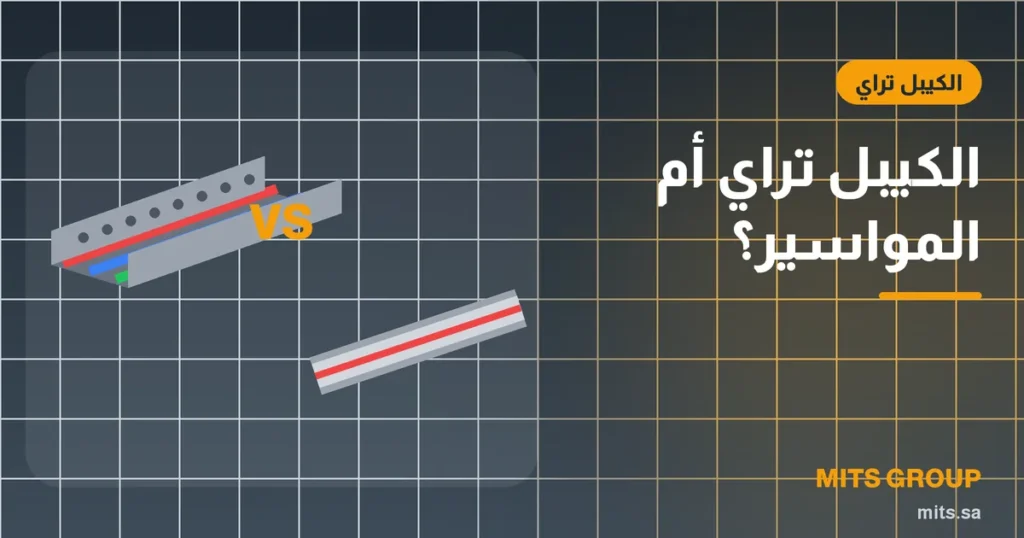
Use cable trays when you have a large number of cables or large-diameter cables running together in a main route, and you need ease of addition and maintenance later. Use conduit for smaller, branch circuits, for running within walls and concrete, and in areas exposed to impact or where people can reach. In most projects, both systems work together: cable trays for the main routes and conduit for the final branches.
- The cable tray is suitable for busy main routes and large cables, and makes adding and checking easier.
- The pipes are suitable for few circuits, buried or concealed extensions, and places that require high mechanical protection.
- Cables on a tray dissipate their heat better than cables crammed inside a pipe.
- The type of cable also determines the choice: some cables are only suitable inside a pipe or enclosed conduit.
What is the main difference between cable trays and pipes?
A cable tray is an open or semi-open support structure, mounted on walls or suspended from the ceiling, onto which cables are laid and tied. Its primary function is to support and organize cables, not to completely enclose them. A conduit, on the other hand, is a closed tube into which the cable is pulled, protecting it from impacts, moisture, and tampering, but it limits the number of cables that can be laid and makes future additions more difficult.
If you want to learn about the different types of trivets themselves (perforated, solid, ladder, and mesh), see the article What is a cable tray and what are its types?Because the choice of type comes after the "tri-am-pipe" decision.
Common pipe types in projects
- PVC pipes: Lightweight, easy to install and rust-free, it is widely used inside walls, ceilings and concrete in residential and commercial buildings.
- Galvanized metal pipes (solid or thin-walled): It provides higher mechanical protection and is used in factories and exposed, impact-prone areas.
- Flexible pipes: For short connections to motors and equipment that vibrate or move slightly.
When is a cable tray the best option?
Trays excel when a project is large and involves a large number of cables. Key examples:
- Main routes in factories and warehouses: From the electrical room to the distribution panels and production lines, dozens of cables run together.
- Large power cables: Pulling a cable with a large cross-section inside a long pipe with bends is a laborious process, while it is easily laid out on the tray.
- Electrical, communications, and server rooms: Connections are constantly changing and require quick access to each cable.
- Commercial solar systems: Assembling and transferring DC panel cables to inverters and then to distribution boards, especially on large roofs and ground-level structures in projects. Solar energy for factories and facilities.
- Projects expected to be expanded: Adding a new cable to an existing tray requires nothing more than unrolling and connecting it, as long as the fullness level allows.
A cooling feature that many overlook
Every cable heats up when current flows through it, and its current-carrying capacity depends on how quickly it dissipates this heat. Cables laid on a perforated or ladder-type tray allow air to circulate around them, while cables bundled inside a closed conduit accumulate heat. Therefore, cable selection tables apply reduction factors for bundles and laying methods, and the same cable may require a larger cross-section if laid inside a conduit with other cables. In hot summer weather, this difference has a significant impact on cost.
When are pipes the right choice?
- The few sub-districts: Lighting, sockets, and terminal connections for one or two devices, where the number of cables does not justify installing a tray.
- Hidden extension: Inside walls, ceilings, and concrete slabs, it is primarily the field of pipes.
- Places vulnerable to impact or tampering: Low walls in warehouses where forklifts pass, and public areas that people access.
- Damp or dusty places: Cables require a sealed sheath, with appropriate connectors and seals.
- Dangerous areas: Such as places containing flammable gases and vapors, and these have special requirements regarding the type of pipes and connections, which are determined by a specialized engineer.
Pipe constraints that must be taken into account
Conduits have much smaller fill limits than treads because cables need space to be pulled without damaging their sheath. Many codes, including the American NEC code, specify a fill limit of 40% of the conduit cross-sectional area when there are more than two cables, and also limit the sum of the bend angles between two pull points. In practice, this means more pull boxes and more conduits as the number of cables increases.
Comparison table: Cable tray vs. pipes
| Standard | cable tray | pipes (Conduit) |
|---|---|---|
| appropriate number of cables | Large, and large-section cables | A few, and sub-circles |
| Mechanical protection | Medium, and increases with the cover or solid type. | High, especially mineral |
| Heat dissipation | Good at drilling and laddering | Weaker with cable bundles |
| Add cables later | Easy as long as the capacity allows | Difficult and may require a new pipe |
| Inspection and maintenance | The cables are visible and easy to trace. | The cable is hidden and needs to be pulled out for replacement. |
| Hidden extension | unsuitable | Suitable for use inside walls and concrete |
| Cost on busy routes | Less often per cable | It increases with the number of pipes and suction boxes. |
Is any cable suitable for extension onto a cable tray?
Not always. Cable laid on an exposed tray must be designed for that purpose, meaning it has an outer sheath to withstand the surrounding conditions and, outdoors, UV radiation. Unsheathed single-core wires used indoors are designed to be run through conduits or enclosed ducts, not laid on an open tray. Therefore, the cable type and the type of support are determined during the design phase, not on-site.
For outdoor, sun-exposed applications, such as rooftops and solar panels, hot-dip galvanized cables with a top cover are preferred. This reduces direct sunlight exposure and protects the cables from dust accumulation. Details on the differences between galvanizing types can be found in the article. Hot-dip galvanized or electro-galvanized cable.
Common solution: Combining the tray and pipes
In a typical factory or warehouse, cables exit the electrical room on a raised main conduit, from which smaller conduit routes branch out to the production areas. Upon reaching each machine or sub-panel, the cable passes into a metal or flexible conduit that protects it at the end exposed to movement and impact. This combination offers both conduit capacity and conduit protection.
For the merger to be successful, pay attention to:
- Use appropriate connectors when the pipe comes out of the tray, so that the cable does not rub against a sharp metal edge.
- Leaving spare capacity in the main tray for future expansions.
- Grounding the trays and metal pipes and connecting them electrically according to the approved plan.
- Separate power cables from communication and control cables, either with a divider inside the tray or with independent paths.
To determine the appropriate tray width and height for your number of cables, try Cable Tray CalculatorThey give you the suggested size and a list of materials initially before you request a quote.
How do you make decisions in your project?
Ask yourself these questions in order:
- How many cables are in this route, and what are their cross-sections? If there are many or large cables, the TRAIN is preferable.
- Is the path hidden inside a wall or concrete? If so, pipes are the solution.
- Is the track subject to impacts, tampering, or access by people? Metal pipes or a solid tray with a cover.
- Are cables expected to increase in the future? The Tri-C saves you from having to redo the work.
- Is the type of cable chosen suitable for exposed wiring? If not, either change the cable or use a conduit.
The final decision in large projects rests with the design engineer and is based on the approved project specifications and requirements. You can review the specifications. The cable tray is manufactured by MITS. To find out the available sizes and thicknesses.
Frequently Asked Questions
Is cable tray cheaper than pipes?
It depends on the number of cables. In busy routes, a conduit is often more economical because it eliminates the need for multiple conduits and pull boxes, while for one or two circuits, a conduit is simpler and less expensive.
Do I need a cover for the cable tray?
Covering is preferred in outdoor areas exposed to sun and dust, and in places where something might fall onto the cables. Inside enclosed roofs, it may not be necessary unless specifically requested by the specifications.
Can power and communication cables be laid on the same tray?
It is preferable to separate them with a metal spacer inside the tray or with two separate paths, to reduce electrical interference on the signal and communication cables.
Is a cable tray suitable for outdoor locations?
Yes, provided that it is hot-dip galvanized or made of a corrosion-resistant material, and that the cables are suitable for outdoor installation and resistant to ultraviolet radiation.
When should I use the flexible tube?
In short connections to motors, pumps and vibrating equipment, because it absorbs the motion and protects the cable at the last part of the path.
Do you need a cable tray for your project? MITS factory in Al-Kharj produces hot-dip galvanized cable trays in various sizes and thicknesses with their accessories, and helps you choose the right size for your routes.
Request a price quote · WhatsApp 0575993880 · Try the cable tray calculator
 Arabic
 English