
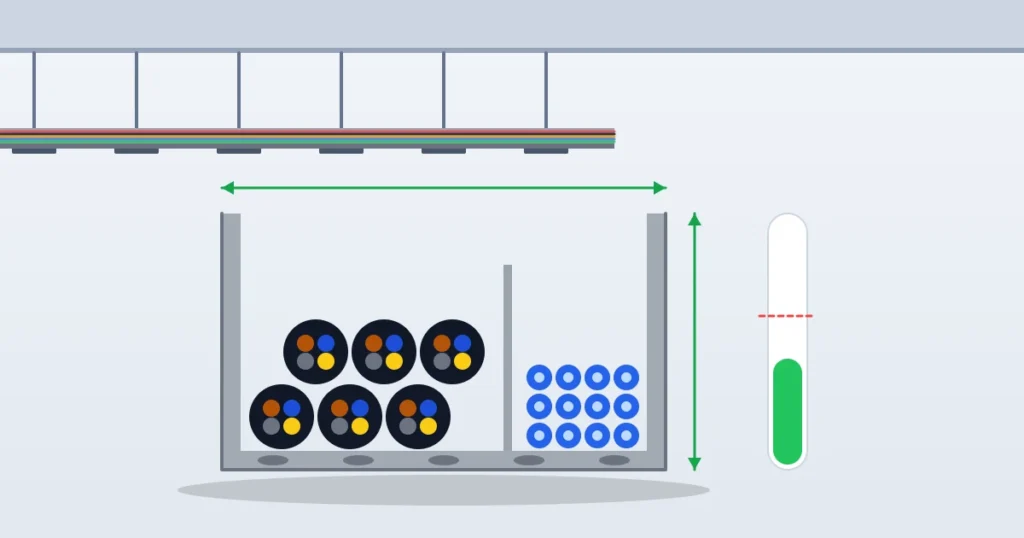
The cable tray calculator selects the appropriate tray size and thickness from the list of cables that will run through it, then calculates the fill percentage and load on each support. It provides a complete list of materials: straight sections, elbows, branch lines, connectors, bolts, and supports, along with the total weight of the steel. You input the tray type, cables, route length, and installation method, and the result appears instantly, along with a cross-sectional drawing of the tray.
- Four types: perforated, ladder, closed, and mesh.
- The cables are added by type, size and number, and the calculator determines their diameter and approximate weight from IEC 60502 tables.
- The size is chosen so that the filling percentage remains within the allowed limit with a reserve capacity for expansion.
- The result includes the maximum distance between supports, the minimum radius of elbows, and the cable bundling coefficient.
Why do you need a calculator to choose a cable tray?
Choosing a trampoline by eye often leads to one of two mistakes: a small trampoline that becomes too bulky and leaves no room for ventilation or expansion, or a large, thick trampoline that unnecessarily increases cost and weight. A calculator balances three things: cable space, its weight on the supports, and the environment in which the trampoline will be installed.
First step: Tri type
| Type | Usual use |
|---|---|
| perforated | Most commonly used in buildings and factories, it protects cables and allows ventilation. |
| Ladder | Heavy cables and long distances between supports |
| Trunking | Complete protection from dust and sun, for exposed areas and sensitive cables. |
| Wire Mesh | Data and low-voltage cables, lightweight and quick to install |
The differences between the types and their materials are explained in the article. What is a cable tray? Its types and uses.
Step two: The cables that will pass through the tray
For each line, you select the cable type (power with different number of poles, control, data and communications, solar panel cable, or custom size), then the cross-section in square millimeters, and finally the quantity. The calculator displays the outer cable diameter and its weight per meter, and sums the following at the bottom: the number of cables, the weight per meter, and the total number of cross-sections.
If you have a cable that is not listed, select «Custom Size» and enter its diameter and weight from the supplier’s catalog.
Step three: Extension method and backup capacity
- Cable arrangement: Multiple layers (the most space-efficient), or a single layer joined together, or a single layer with gaps to improve cooling.
- Reserve capacity: A percentage is added for future expansions, and the default is 25%.
- Triangle height: Leave it to automatically select the most suitable calculator, or specify it as 50, 75, or 100 mm.
- Additional load: If the tray is going to carry something other than cables.
- Metal separator: Required when data or alarm cables run along with power cables in the same tray.
Step Four: Path, Installation, and Environment
The length of the track, the number of horizontal and vertical elbows, branches, intersections and miniatures, and the method of installation are taken into account: suspended from the ceiling with rods and a channel, or on the wall with cantilevers, or on the floor and roof with bases. Then the distance between the supports and the length of the suspension are taken into account.
Finally, consider the installation environment: dry indoors, exposed outdoors, coastal or high-humidity, chemical, or food and pharmaceutical. The calculator recommends the appropriate finish for each environment, and you can manually select it: pre-galvanized, hot-dip galvanized, powder-coated, or 304 and 316 stainless steel. For a comparison of galvanizing types, read [link/reference]. Hot-dip galvanizing or electro-galvanizing.
Illustrative example: A 60-meter route for power and data cables
This is a hypothetical example when the calculator is opened; the numbers are approximate:
- Cables: 6 4-pole 6mm² cross-section power cables (approximate diameter 18.3mm), and 12 Cat6 data cables.
- Total: 18 cables, weighing 5.5 kg/m, with a total cross-sectional area of 1,940 mm².
- Multiple layers, 25% backup capacity, metal separator between power and data.
- The track is 60 meters long, with 4 horizontal elbows, 2 vertical elbows, and 2 T-braces, suspended from the ceiling with a support every 1.5 meters, in a dry indoor environment.
Result
| Item | Value |
|---|---|
| Recommended size | Perforated tray 100 x 75 mm, 1 mm thick, pre-galvanized |
| Filling percentage | 26% out of a maximum of 40% |
| Carry cables with backup capacity | 6.9 kg/m |
| Approximate safe load for the tricycle | 109 kg/m |
| Maximum distance between supports for this load | 5.25 m |
| Minimum radius of bending for elbows | 146 mm, so 150 mm elbows were chosen. |
| Cable assembly plant | 0.57 for six circles |
| Total weight of iron | 212 kg |
The list of materials includes: 21 3m long tray pieces, 4 horizontal elbows, 2 vertical elbows, 2 branch elbows with a radius of 150mm, 21 metal spacers, connecting plates and bolts, and Unistrt brackets with M10 toothed bars.
How do you read engineering tests?
- Filling percentage: The further you get from the maximum limit, the cooler the Trio will be and the easier it will be to pull and expand.
- Grouping factors: It reminds you that adjacent cables heat up more, so the electrical designer may need to increase the cable cross-section or extend it with a single layer.
- Radius of curvature: Elbows that are smaller than the limit put stress on thick cables.
- The load on each support: It helps in selecting the appropriate rails and brackets for the ceiling.
The method for manually calculating the percentage of fullness and weights is explained in the article. How to choose the right cable tray sizeInstallation steps and distances in Cable tray installation.
Frequently Asked Questions
Should I rely on the calculator's size in the diagrams?
It is a good initial choice, but the safe load is an estimate and ultimately depends on the manufacturer's schedules and project details, so check it with your electrical engineer.
Why did the calculator recommend pre-galvanized and not hot-dip galvanized?
Because the chosen environment is indoor and dry. If you choose an outdoor or coastal environment, the recommendation changes to a stronger finish.
Does the calculator calculate the top cover?
Yes, activate the top cover option to add it to the list of materials and weight.
Does the calculator include installation?
You can activate the installation option to add to the estimate, and the final price will be in the official offer.
Do you need a cable tray for your project? MITS GROUP factory in Al-Kharj manufactures perforated, ladder and closed cable trays with elbows and accessories, with a galvanized or powder-coated finish depending on the environment, and prepares quantities according to your plans.
Request a price quote · WhatsApp 0575993880 · Cable Tray from MITS factory
 Arabic
 English