
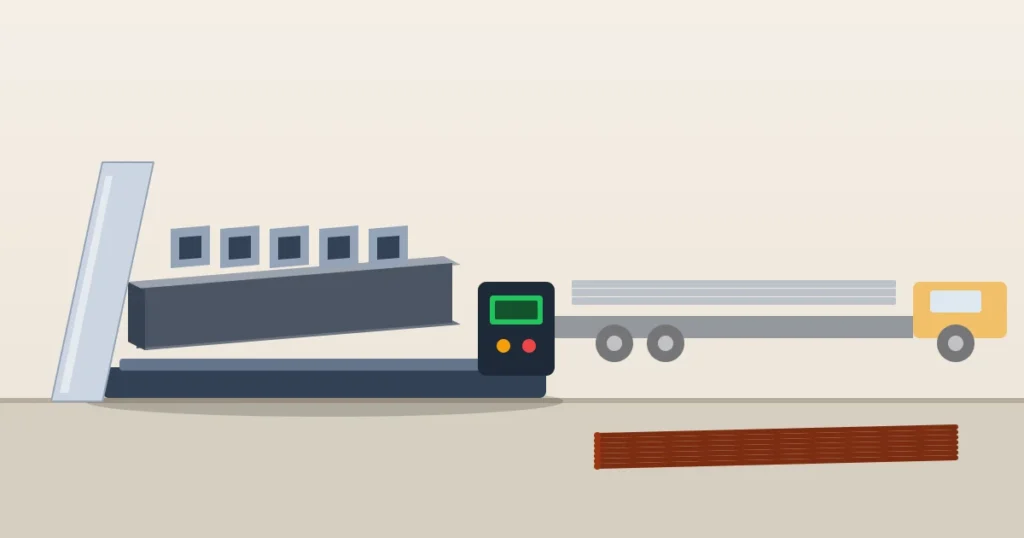
The steel weight calculator compiles your entire order into a single table: square, rectangular, and round pipes; angles and profiles; sheet metal; C and Z purlins; IPE and HEA beams; UPN conduits; and reinforcing steel. For each piece, you select the shape and material, enter the dimensions, length, and quantity, and it provides the weight per meter, per piece, and per quantity, then the total weight in kilograms and tons, the longest piece, and the appropriate truck type for transport.
- It supports hollow and solid sections, sheet metal, standard beams and reinforcing steel in one order.
- Four materials: black iron, galvanized iron, stainless steel, and aluminum, each with its own density.
- Standard bridges have their weights taken from tables according to EN 10365.
- It alerts you if there are pieces longer than 6 meters that require a flatbed truck or a long lorry.
When should you use an iron weight calculator?
Weight is the language of the steel market: it's priced in kilograms, transported by weight and length, and factored into structural load calculations. Use a calculator when:
- You are preparing quantities for a small project (awning, fence, tank structure, gate) and want to know the load before purchasing.
- It compares offers from suppliers with different thicknesses for the same size.
- You need to know the number of trips or the type of truck before supplying.
- You want to estimate the weight of a structure that will be mounted on a surface.
How do you add the pieces?
Each line in the calculator is a piece. You choose:
- Shape: Hollow square (SHS), hollow rectangle (RHS), round pipe, L angle, simplified, sheet metal, round or square solid, C or Z purlin, IPE or HEA bridge, UPN conduit, or reinforcing steel.
- Material: Black iron, galvanized, stainless steel, or aluminum.
- Sizes: In millimeters for rib, thickness and diameter, or choose the size from the list for standard bridges.
- height By the meter, andnumber.
Under each line, three numbers appear: weight per meter, weight of the item, and total for this item. Then press "Add Item" for the next line.
Additional services: Cutting and galvanizing
- Cut the pieces to size: A fixed price is added per piece.
- Hot-dip galvanizing of black iron: The calculator adds the weight of zinc and estimates it to be about 5% of the weight of iron.
If you want to understand galvanizing and its stages, read the article The difference between hot-dip galvanizing and electro-galvanizing.
Illustrative example: Mixed order for a small structure
This is a hypothetical example in the calculator; the numbers are approximate:
| piece | Material | number | kg/m | Weight |
|---|---|---|---|---|
| Hollow square 50 x 50 x 2 mm, length 6 m | black iron | 10 | 3.01 | 180.9 kg |
| Sheet metal 2,440 × 1,220 × 1.5 mm | galvanized | 5 | — | 180.5 kg (36.1 per slab) |
| IPE 200 bridge, 12 m long | black iron | 2 | 22.40 | 537.6 kg |
The result: 17 pieces with a total weight of approximately 899 kg (0.899 tons), of which 718.5 kg was black iron and 180.5 kg was galvanized. The longest piece was 12 meters, so the calculator suggested... 12m flatbed For transport, she noted that pieces longer than 6 meters require a flatbed truck or a long lorry.
How do you manually verify a single number?
Take a square pipe 50 × 50 × 2: the area of the metal is approximately 4 × 2 × (50 − 2) = 384 mm², and each mm² of one meter weighs 0.00785 kg, so the weight is approximately 3.01 kg/m². This is what the calculator gave. The complete equations are in the article. Calculating the weight of sheet metal, pipes, and sections.
Why does the weight of a calculator differ from the weight of a scale?
- Manufacturing Permissions: The actual thickness differs slightly from the nominal thickness, and the calculator notes that the difference may reach ±3%.
- Rounded corners In square and rectangular pipes.
- Galvanizing and painting It adds weight.
- The deceased: The weight of the finished pieces is less than the weight of the raw material purchased due to the shearing residues.
Tips for using the result in purchasing and transportation
- Request the thickness by number: Two offers of the same size but with different weights often mean different thicknesses.
- Pay attention to the longest piece: It's the weight that determines the type of truck. Sometimes cutting and welding a long piece on-site is cheaper than transporting it whole, and that's a decision for the designer to make.
- Separate the materials: The calculator displays the weight according to the material, which is useful because the price per kilo varies between black, galvanized, and stainless steel.
- Calculate the loads: If the structure is on a roof, the weight of the iron is part of the load that the roof must bear.
Frequently Asked Questions
Does the calculator calculate the weight of aluminum?
Yes, choose aluminum because it has a lower density, so the weight will be about one-third the weight of iron for approximately the same dimensions.
Where do the weights of IPE and HEA bridges come from?
From the standard tables according to EN 10365, you do not need to enter the bridge dimensions, just choose the size.
How do I calculate the amount of reinforcing steel?
Select "reinforcing steel" and specify the diameter, length, and quantity. The standard formula is: weight per meter = diameter² ÷ 162.
Does the calculator add the weight of zinc to pre-galvanized iron?
It does not add extra to pre-galvanized steel. The additional galvanizing option adds approximately 5% only when galvanizing black iron.
Do you need iron manufactured or supplied for your project? MITS GROUP factory in Al-Kharj manufactures metal structures and parts according to plans using cutting, shaping and CNC, with hot-dip galvanizing, and helps you calculate quantities and weights before implementation.
Request a price quote · WhatsApp 0575993880 · MITS Metal Manufacturing Plant
 Arabic
 English